
Listening to Place
Günther Oberhollenzer
There are works that transform a place. And there are works that allow it to speak. The works of Studio C&C belong to this second, rarer category. They do not enter the landscape to mark it or dominate it. Rather, they emerge from an attentive dialogue with what is already there – with the relief of the terrain, with the traces of human use, with the inherent temporalities of wood, stone, metal or water, with the light that first brings a space into being. Their art begins where design gives way to perception.
I.
“We grew up surrounded by nature,” say Mariagrazia Abbaldo and Paolo Albertelli. “The experiences of our childhood and our engagement with nature writing continue to shape our understanding of space.”
This biographical and intellectual background forms the foundation of Studio C&C’s practice. Since 1997, the Turin-based studio has developed projects at the intersection of site-specific and landscape- based art, sculpture and architecture, in which landscape, material and built space are brought into relation with one another.
In a multimedia present increasingly shaped by speed, visual overproduction and sensory overload, the works of C&C take on an almost resistant quality. They elude the logic of the spectacular. Their language is quiet, precise and marked by a profound sensitivity to material. They assert nothing. They open.
This attitude recalls one of the central insights of Maurice Merleau-Ponty’s phenomenology: perception is not a detached act of observation but a bodily relationship with the world. Human beings do not stand opposite the landscape – they are embedded within it. Space arises not through geometry alone, but through experience.1 It is precisely here that the works of Studio C&C begin. They are less objects than situations of perception. They transform not only the place itself, but also the way we move within it, how we experience light, touch material or judge distance.
II.
“Landscape is a space for reflection,” say Abbaldo and Albertelli, “a place of inspiration where feelings arise.” Their works are not intended to convey unequivocal messages. Rather, they emerge from the conviction that knowledge is not gained through concepts alone, but from personal, sensory experience. By removing forms of nature from their landscape context and transferring them into new, often architectural contexts, they open up possibilities for seeing landscape with different eyes. At the centre is an attitude of respect – towards nature, its processes and the materials it brings forth.
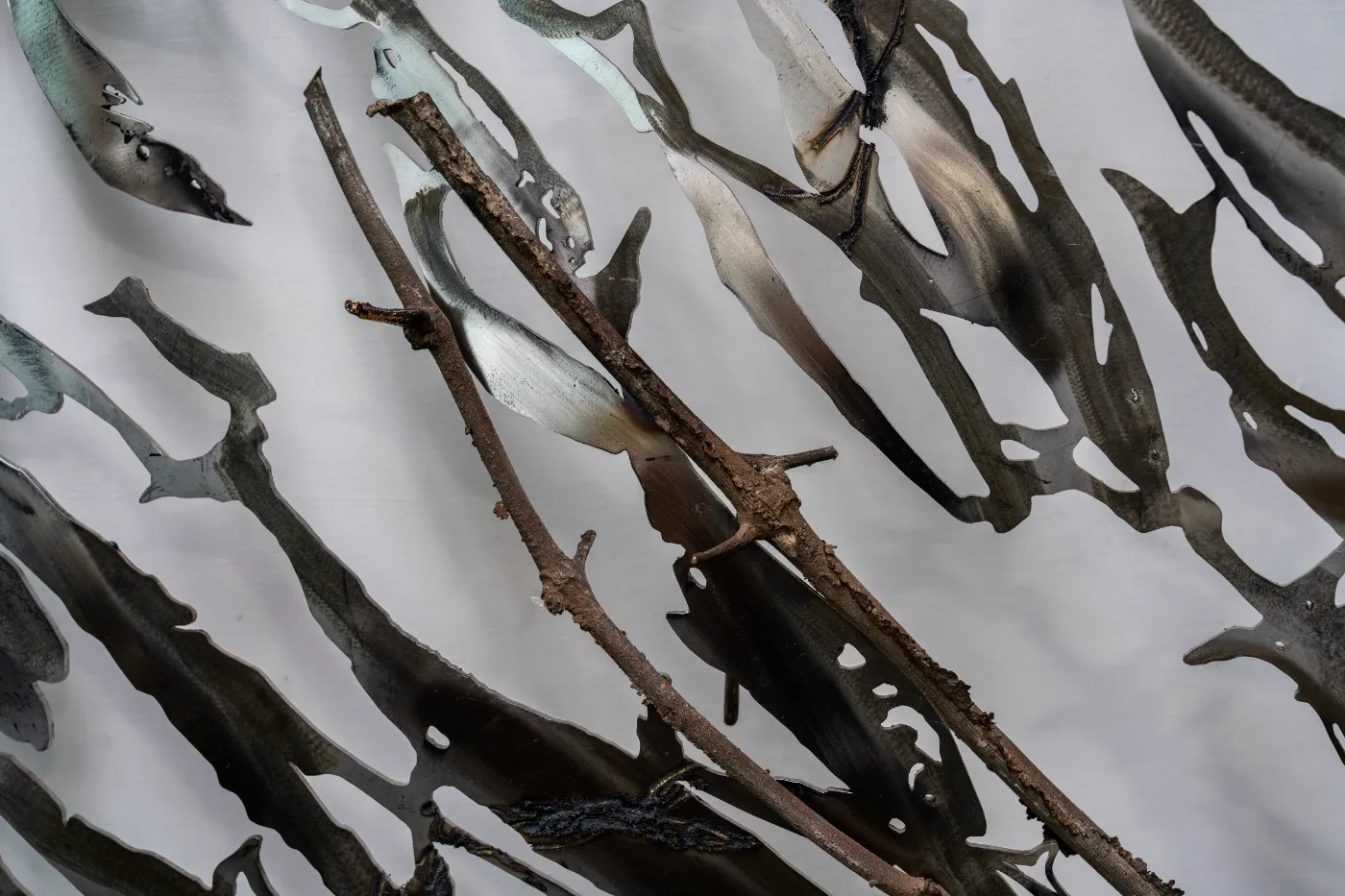
The sculptures and architectural interventions often appear as though they had not been added, but uncovered. Wood remains wood. Stone remains stone. Iron bears its weight not as a burden, but as a memory. The materials do not deny their origin; they speak of growth rings, erosion, oxidation and ageing. Here, time appears not as a theme of art, but as its actual material.
III.
A proximity to Arte Povera can be discerned – not as a stylistic reference, but as a shared attitude. Like the artists of this movement, Studio C&C places its trust in the inherent logic of the material and in the poetic power of simplicity. Yet whereas Arte Povera often emphasised the social and political character of matter, the focus here shifts to the place itself. Material becomes the medium of a relationship. It connects landscape and architecture, memory and the present, body and space.
This understanding of space as relationship finds a counterpart in the Japanese concept of Ma. The word does not denote emptiness in the Western sense, but the meaningful interval – that in-between in which relationships can arise. Ma describes the quality of a pause, a distance, a silence that is not lack, but possibility.2 Many works by Studio C&C seem to grow precisely from this way of thinking. They define spaces not through mass, but through intervals; not through fullness, but through openness. The invisible acquires the same significance as the visible. Light becomes material. Shadow becomes form. Silence becomes part of the composition.
IV.
The works never speak exclusively of themselves. They speak of the wind passing through a structure. Of the changing seasons. Of the slow transformation of a surface. Of the viewer’s step, which first activates the space. The place does not become a stage for art; it becomes its co-author. Herein lies a remarkable form of modesty.
Studio C&C understands design not as an act of control, but as an exercise in listening. The artistic gesture recedes behind what it seeks to make visible. An aesthetics of attentiveness emerges – a practice aimed less at production than at resonance.
The sociologist Hartmut Rosa describes resonance as a relationship to the world in which both sides touch and transform one another without making one another available.3 It is precisely this quality that seems present in the works of Studio C&C. Their art responds to what is already there without bringing it to a close. It changes with the weather, with the light, with the people who seek it out. Each encounter writes the place a little further.
V.
Perhaps true poetry lies in the everyday. Not in the extraordinary, but in rediscovering what is taken for granted. Not in the monumental, but in looking closely. The works of C&C remind us that landscape is not merely nature, but a fabric of memories, stories and material processes. That architecture is not simply built space, but lived experience. And that art need not always produce new images, but that sometimes it is enough to open our eyes to what has long been there.
“We have always believed that there is no difference between an architect and an artist,” say Abbaldo and Albertelli. For them, the architectural scale opens up the possibility of thinking of sculpture as a space that can be entered and experienced. A sculpture becomes architecture when it transforms the place in which it is embedded and endows it with new qualities. It is not merely an object in space, but participates in shaping that space. In this way, architecture and sculpture intertwine to form a spatial experience that subtly shapes people’s everyday lives.
VI.
“Not necessarily,” the artist duo finally reply when asked whether the meaning of a sculpture changes when it is shown in a gallery rather than in public space. What matters is not the exhibition venue, but the conception of the work. While some sculptures retain their meaning regardless of context, others unfold their true effect only in relation to the space they shape. Their monumental works in particular are conceived for this dialogue with their surroundings.
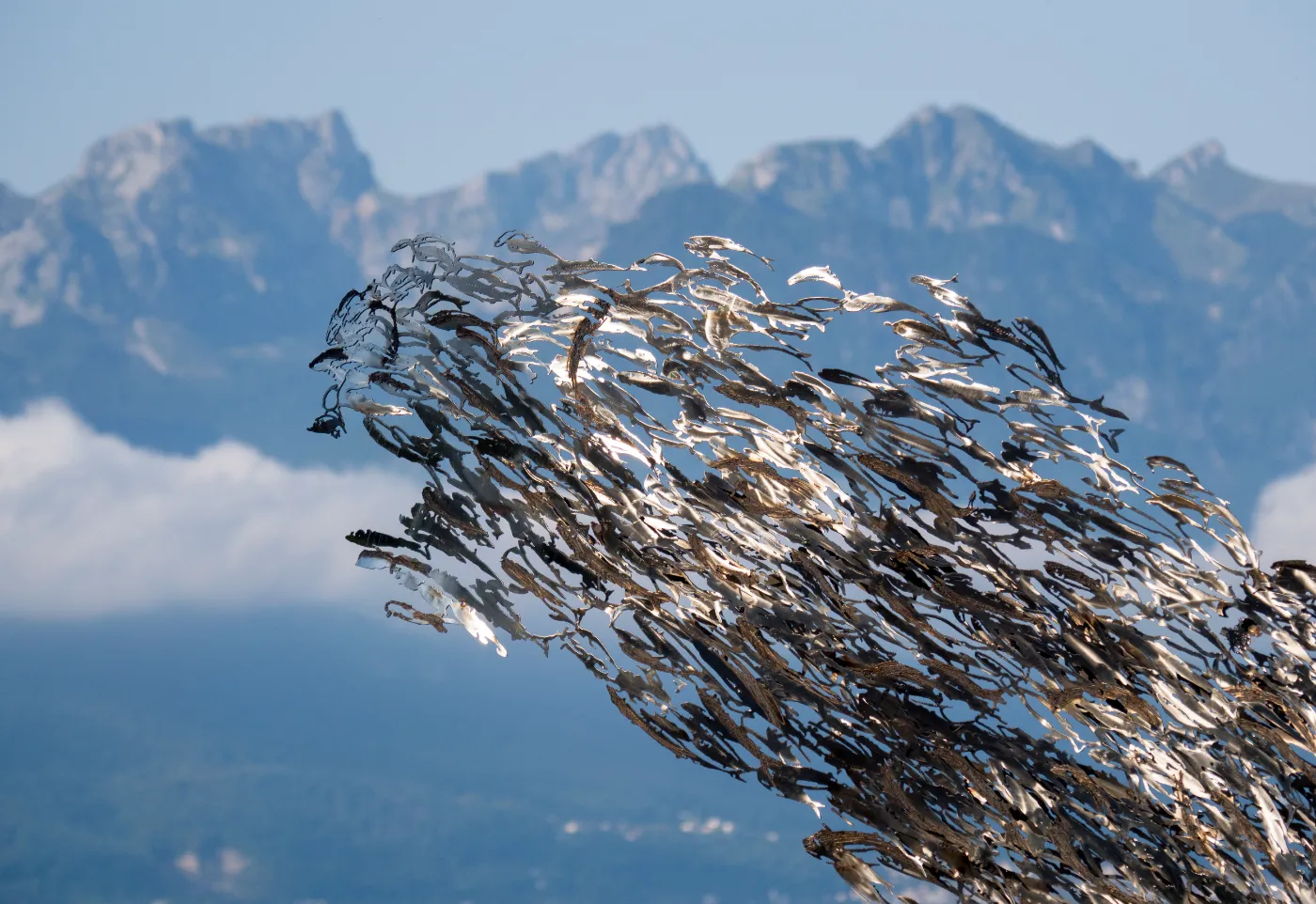
The exhibition presents, in sculptures and site-specific installations, some of the fundamental motifs of their work – delicate tree and forest objects, reminiscent of our venous and cerebral vascular systems, enter into dialogue with the wall (the cast shadows!) and the space, which are populated by small- scale, dynamic schools of fish and gatherings of people. Also on view are scale models that make the architectural dimension and spatial idea of the realised works comprehensible on a smaller scale.
VII.
Mariagrazia Abbaldo and Paolo Albertelli understand their works as an invitation to an encounter. They do not offer ready-made answers, but open spaces for curiosity, feeling and imagination. If their works leave behind a “beautiful emotion” and awaken the desire to look at the world with different eyes, they have achieved their aim. At best, visitors take with them the experience of having come closer to art – and perhaps also to their own perception.
Thus, what we see are works that resist rapid consumption. They demand time – and at the same time give it back. Those who encounter them leave not with an unequivocal message, but with a new perspective. Perhaps this is precisely the most enduring form of artistic experience: when it is not the work alone that remains in memory, but the world afterwards appears a little different.
References
1 Maurice Merleau-Ponty, Phänomenologie der Wahrnehmung, de Gruyter, Berlin, 1974.
2 Arata Isozaki (ed.), MA: Space-Time in Japan. Catalogue of the exhibition of the same name at the Cooper-Hewitt Museum, New York, 1979.
3 Hartmut Rosa, Resonanz. Eine Soziologie der Weltbeziehung, Suhrkamp, Berlin, 2019.
Note
The quotations by Mariagrazia Abbaldo and Paolo Albertelli are taken from an email interview conducted by the author with the artist duo in July 2026. The interview was conducted in Italian; the German translation is by the author.